
Compute has a turkey problem
Written with LLM assistance. Details at the end.
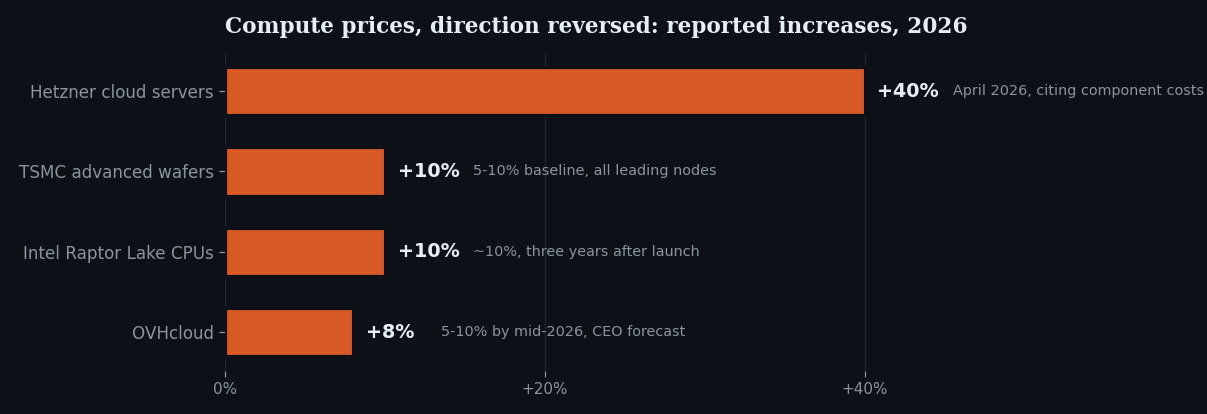
This chart is something we are not used to seeing. The price of compute has always trended lower, while the hardware kept getting more efficient at the same time. Whole careers, languages and architectural philosophies were built on the assumption that CPUs are abundant and will cost less next year.
The evidence that the assumption no longer holds, at least for a while: Hetzner citing component costs, Intel raising CPU prices three years after launch, TSMC lifting every leading node, and OVHcloud telling customers more is coming. Behind it, the hyperscalers are pouring hundreds of billions a year into new datacenters. Every one of those machines bids for the same wafers, power, and rack space your next CPU instance comes from.
Things were not always this way. The computer that landed people on the Moon had about 4 KB of RAM and executed roughly 85,000 instructions per second. Its source code, printed out, made a stack of paper as tall as Margaret Hamilton, who led the team that wrote it. Cycles weren’t a budget line, they were the design constraint. During Apollo 11’s final descent, a rendezvous radar left in the wrong switch position started flooding the guidance computer with counter interrupts, silently stealing roughly 15% of its cycles, and with Armstrong and Aldrin minutes from the surface the machine ran out of headroom. It did not crash. The famous 1201 and 1202 alarms it threw were not the failure. They were the software’s designed response to overload firing exactly as built: restart, shed every low-priority job, keep the landing-critical ones running on the cycles that remained. Mission control called “go” on the alarms and Eagle kept flying. Don Eyles, who wrote the lunar-landing software in Hamilton’s group at the MIT Instrumentation Laboratory, tells the story firsthand in Tales from the Lunar Module Guidance Computer. That is what engineering looks like when every cycle is valuable.
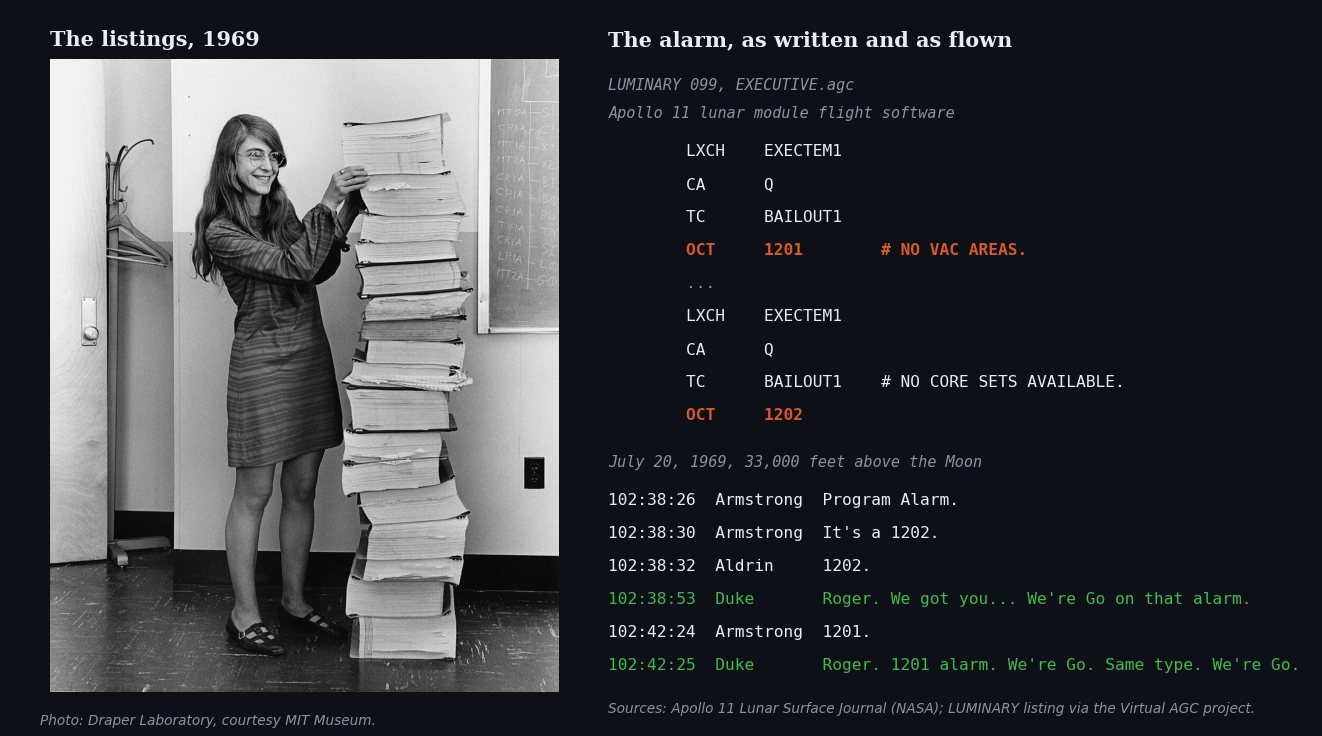 Left: Hamilton beside the listings of the software her team wrote.
Right: the lines in the lunar module’s flight software
that raise the 1201 and 1202 alarms, and the transcript of
the moment they fired.
Left: Hamilton beside the listings of the software her team wrote.
Right: the lines in the lunar module’s flight software
that raise the 1201 and 1202 alarms, and the transcript of
the moment they fired.
At some point, cycles became abundant and we built an entire engineering culture around that abundance. Niklaus Wirth was already complaining about it in 1995 in A Plea for Lean Software, and “software is getting slower more rapidly than hardware becomes faster” now has a name, Wirth’s law. The modern version of the rant is a genre of its own (Muratori’s is the classic). We stopped asking what a cycle costs because the answer almost never mattered.
Interpreted languages in the hot path, a hundred-fold overhead, whatever: the hardware will absorb it. It was even the rational call for some scenarios. Engineer time was the scarce input. CPU time was not.
CPU Thanksgiving
In The Black Swan, Taleb tells the story of a turkey that is fed every day for a thousand days. Plot its well-being and you get a smooth rising line, and every new day of data makes the extrapolation look safer. Then, a few days before Thanksgiving, the process generating the data changes, and the line does something the previous thousand points gave no warning of. That is the turkey problem. It is about extrapolation: a long, consistent trend describes the past of a process, not whether the process will keep running. Twenty years of always-cheaper compute is a long, consistent trend. It was never a law of nature, just the output of fab economics and demand sitting comfortably below supply, and the demand side just changed.
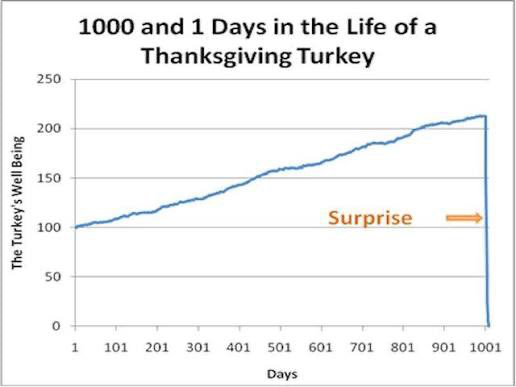 The turkey’s data, from Nassim Taleb’s The Black Swan. A thousand
clean data points, one broken process.
The turkey’s data, from Nassim Taleb’s The Black Swan. A thousand
clean data points, one broken process.
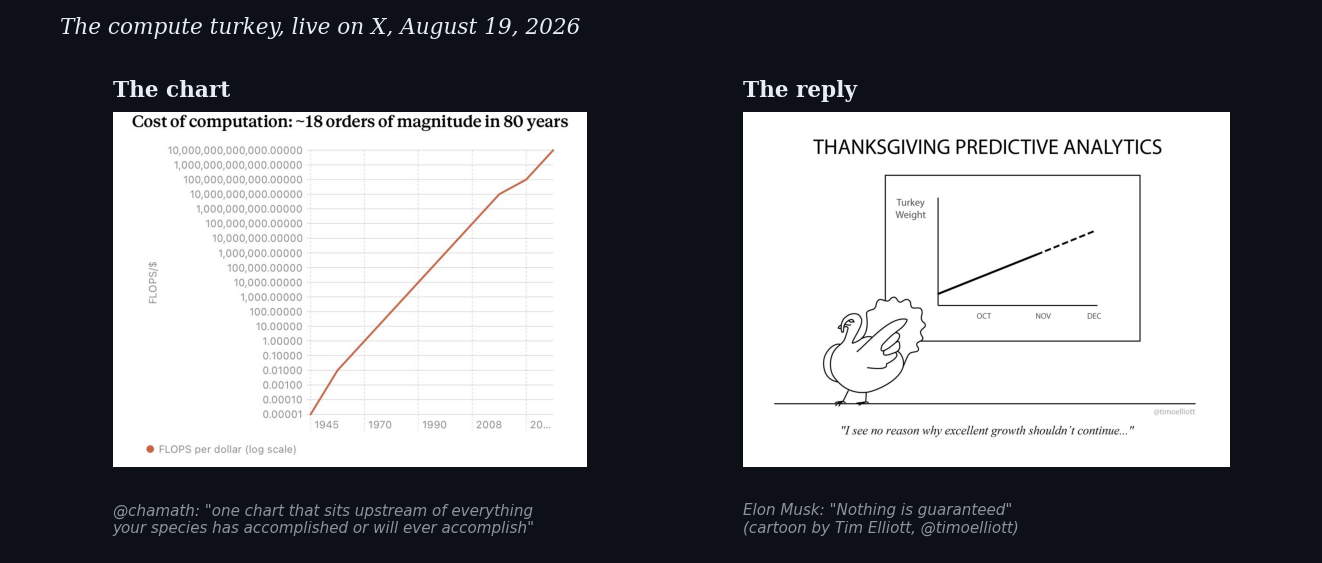
Then, in August 2026, the argument staged itself on X in a single exchange. Chamath posted the cost-of-computation curve, 18 orders of magnitude in 80 years, calling it the one chart that sits upstream of everything our species has accomplished, as long as we keep it going. Musk’s reply was a cartoon turkey presenting its own weight chart, captioned “I see no reason why excellent growth shouldn’t continue,” with three words of commentary: “Nothing is guaranteed”.
Day 1,001
Behind the prices, the physical constraints are blunt: North American datacenter vacancy has sat at ~1% for three years (CBRE), grid transformers quote 128-week lead times, and Microsoft’s CFO said it plainly: “We have been short of power and space.” The capacity being built through 2028 is already spoken for. Whatever this turns out to be, it does not resolve next quarter.
The tax
How much CPU is actually on the table? For compute-heavy loops, C++ is routinely one to two orders of magnitude faster than Python. Even I/O-heavy services, where the interpreter spends most of its time waiting on something else, tend to land somewhere between 2x and 5x. Either way it is a cost story: save the CPU-seconds and the dollars follow.
And CPU-seconds are servers. Meta’s fleet profiler found a one-character C++ fix (a copy that should have been a reference) worth an estimated 15,000 servers a year of capacity (Strobelight, in the section “The Biggest Ampersand”).
So here is a practical question: when did you last profile your compute-heaviest workloads? An afternoon with a profiler usually turns up a shortlist of Python loops responsible for a surprising share of the bill, and those are the natural candidates for a C++ port. What kept shortlists like that unacted on for years was not the measurement but what came after it. The rewrite carried the cost of the bridge: hand-written pybind11 glue, a second build system, stubs that drift, a maintenance surface nobody wants to own. The cycles were cheaper than the glue.
That trade deserves a rerun, because the bridge side of it quietly collapsed. C++26 reflection lets a binding layer derive the glue from the class itself: mirror_bridge turns a C++ struct into a Python module with one command and zero hand-written binding code. The bridge is now almost free!
Try it
Here is the whole workflow on a header the binder has never seen, with the timing of the real run:
The command is one line:
mirror_bridge generate include/ --module vec3 --lang python --release-gil --stubs
A quick tour of what that line does. generate include/ scans the
directory and discovers every class in it, so there is no list of
things to bind. --module vec3 names the Python module you will
import, and --lang python picks the target (Lua and JavaScript are
the other options). --release-gil makes the generated methods drop
Python’s global interpreter lock while the C++ body runs, so a long
native call no longer blocks your other Python threads. --stubs
writes a vec3.pyi next to the module with the exact signatures and
parameter names taken from the C++ class, which is what gives you
autocomplete and type checking in the editor.
The maintenance story is the part that usually kills these tools, so it deserves a plain answer. The C++ you own is an ordinary header. No macros, no annotations, no wrapper classes, no second build system. When the class changes, you rerun the same command and the module and its type stubs are regenerated from the class itself, so there is nothing to keep in sync by hand.
How much you get back depends on the shape of the hot path, and I have written up real cases at both ends: porting Open3D (25,262 hand-written binding lines to 71) and racing the generated bindings against V8, PyPy, and LuaJIT.
The point
None of this is an argument to rewrite your service in C++. It’s an
argument that the old equilibrium, leave it in Python, the rewrite
isn’t worth the bridge, was priced against hardware that got cheaper
every year and glue that cost weeks. Both inputs changed. The bridge
is now one command on stock GCC 16.1 with -std=c++26 -freflection
(reflection is in C++26, this is standard C++). Move the
hundred-odd lines that burn 80% of your cycles and leave everything
else where your team is productive.
Disclaimer
This post was written with LLM assistance. The opinions and the mistakes are mine.